


What is IELTS?
 This exam offers two variants: Academic and General Training. The Academic module caters to individuals aspiring to pursue higher education in English-speaking nations, while the General Training module is suitable for those seeking employment opportunities or migration. Available in both paper-based and computer-based formats, the IELTS comprises four sections: listening, reading, writing, and speaking. Notably, the speaking section stands out due to its interactive nature, where candidates engage in face-to-face conversations with examiners, fostering a conducive environment for authentic communication in English. This emphasis on real-life communication situations distinguishes IELTS from other language proficiency tests, making it a preferred choice for many aspirants. Additionally, the flexibility of retaking the exam multiple times, albeit for a nominal fee, further enhances its appeal.
Read More: Things to Keep in Mind While Taking Your First Study Abroad Entrance Exam
Scoring of IELTS Exam
Let’s explore the scoring system of the IELTS exam. The International English Language Testing System (IELTS) employs a scoring scale ranging from 0 to 9, known as band scores. Each band score corresponds to a specific level of English proficiency. Here’s a breakdown of the band score descriptions:
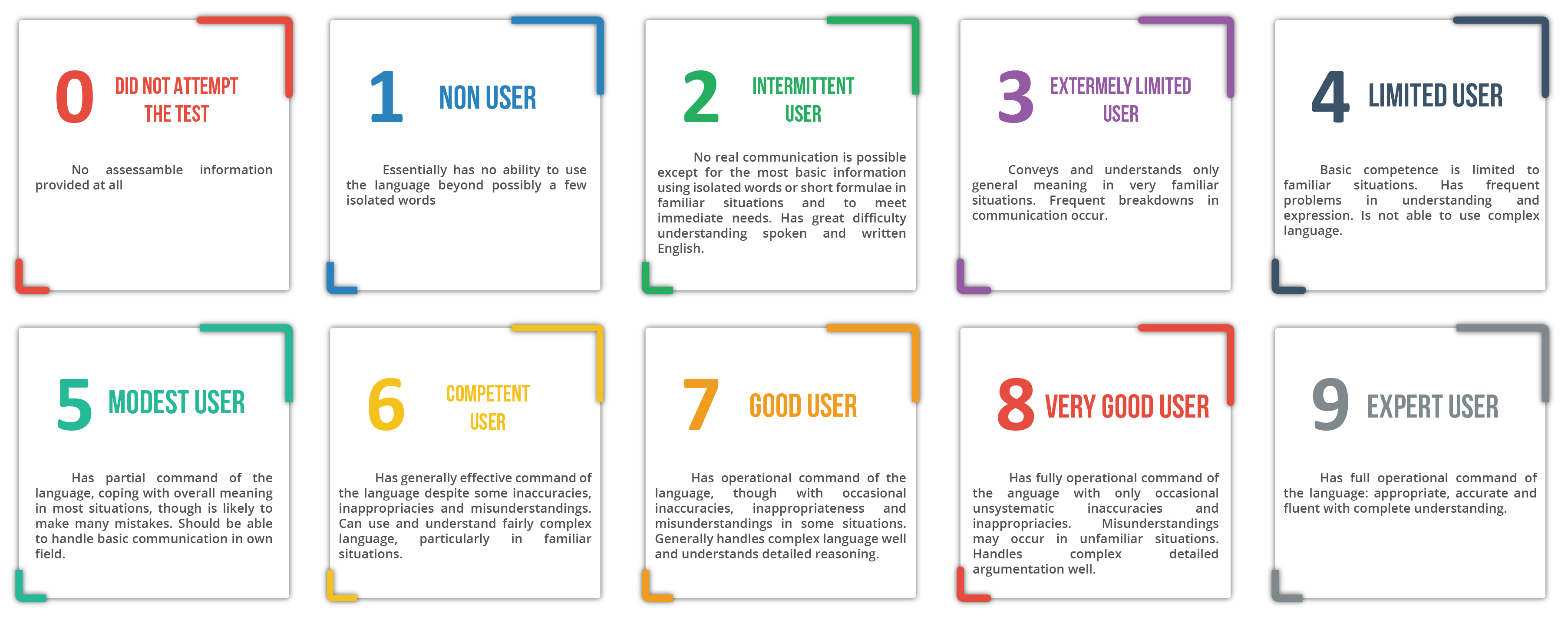 Band 9: Expert User: Individuals with a band score of 9 exhibit complete command over the English language. They demonstrate accuracy, appropriateness, flexibility, and fluency in their communication, with a thorough understanding of nuanced language usage.
Band 8: Very Good User: Test-takers scoring an 8 possess excellent command of English, with only occasional, unsystematic errors. They handle complex language structures adeptly and can engage in detailed arguments effectively, albeit with rare errors.
Band 7: Good User: Those achieving a band score of 7 demonstrate a solid command of English, albeit with occasional inaccuracies or inappropriate word choices. They can navigate complex language scenarios competently and comprehend detailed arguments reasonably well.
Band 6: Competent User: Test-takers scoring a 6 display effective command of English, despite some errors, occasional misunderstandings, or inappropriate language usage in certain contexts. They can communicate proficiently, particularly in familiar situations, and utilize some complex language structures.
Band 5: Modest User: Individuals with a band score of 5 possess a partial command of English, capable of grasping overall meaning but prone to frequent errors. They exhibit better language proficiency in common situations but struggle with complex language usage.
IELTS scores are determined based on performance across the four sections of the exam: listening, reading, writing, and speaking. Test-takers receive a separate band score for each section, which is then averaged to calculate an overall band score. This comprehensive assessment offers insights into an individual’s English language proficiency across various communication skills.
Significance of IELTS Score in Admission
The significance of the IELTS score in securing admission to a Canadian university cannot be overstated, as nearly every institution in Canada mandates the submission of an IELTS score by applicants. For those seeking a Canadian visa for undergraduate studies, a minimum overall IELTS score of 6 is typically required, with a score of 5.5 in each segment. Graduate program applicants, on the other hand, are often expected to achieve a minimum average IELTS score of 6.5, with no segment scoring below 6. For the Student Direct Stream Program, a minimum IELTS score of 6.0 or higher in each skill (reading, writing, speaking, and listening) is necessary.
Prospective students can also refer to the Canadian Language Benchmarks (CLB) to ascertain the specific minimum IELTS score requirements for their chosen universities and programs. However, it’s crucial to note that these requirements may vary from one institution to another and from program to program.
Let’s now explore the mandatory IELTS score prerequisites for several top-ranking Canadian universities.
- University of Toronto
- McGill University
- University of British Columbia
- University of Alberta
- McMaster University
- Concordia University
- University of Windsor
- Dalhousie university
- University of Waterloo
- Centennial College
- Humber College
- George Brown College
- Conestoga College
- Seneca College
Benefits Beyond Admission: Impact of IELTS Scores
Increase in Express Entry Points: Achieving a high IELTS scores can significantly augment an individual’s Express Entry points, facilitating a smoother path towards permanent residency in Canada.
Enhancing Application Profiles: Exceeding the minimum IELTS requirements can distinguish applicants, potentially attracting attention from admission committees and bolstering their application profiles.
Opportunities for Teaching Assistantship: A commendable IELTS score, coupled with relevant qualifications, enhances the likelihood of securing teaching assistantship roles, providing valuable opportunities for professional development.
Conclusion
In conclusion, IELTS scores play a crucial role in the university admissions process for international students aspiring to study in Canada. By understanding the significance of these scores, preparing effectively for the exam, and exploring available support services, prospective students can enhance their chances of success in securing admission to their desired Canadian universities.
FAQs
1. What is the validity period of an IELTS score?
The IELTS score remains valid for two years from the date of the test.
2. Can I retake the IELTS if I’m not satisfied with my score?
Yes, candidates can retake the IELTS to improve their scores.
3. Do all Canadian universities require IELTS for admission?
Most Canadian universities require IELTS scores for international applicants, but requirements may vary.
4. Can I use my IELTS score for immigration purposes?
Yes, a high IELTS score can contribute to your points under the Express Entry system for Canadian immigration.
5. Are there any exemptions from taking the IELTS for admission to Canadian universities?
Some universities may waive the IELTS requirement for applicants from English-speaking countries or those who have completed their previous education in English.
